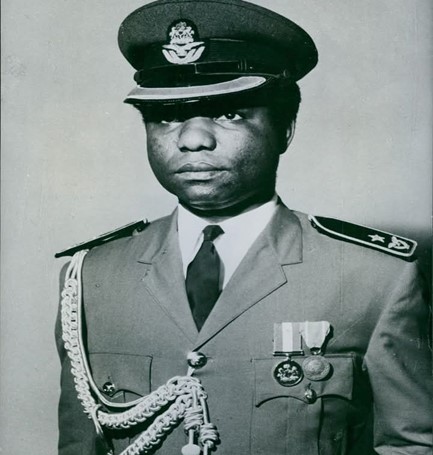
Brig-Gen. Udoakagha Jacob Esuene, Atta of Eket:
A true son of Ekidland, an Upright Military Officer, Astute
Administrator, Pioneering State Governor, Ibibio Pioneer, a Loving Husband and
Father (October 7, 1936 – April 6, 1993)
by Samuel Asamudo
Introduction
Retired Brigadier-General Udoakagha
Jacob Esuene was the first Military Governor of South-Eastern State from May
27, 1967 to July 29, 1975 under the General Yakubu Gowon-led Federal Military
Government of Nigeria.
According to late Governor
Esuene’s wife, Her Excellency Senator (Archbishop) Helen Esuene, while the civil
war was still ongoing in Calabar and in other parts of the newly created State,
the Secretary to the State Government and Head of Service, Chief Michael Ani, started
operating from a temporary office at Ogoja (Abang 2017). According to Her
Excellency, Chief Ani moved to Ogoja to commence the distribution of relief
materials to the liberated areas of the state.
Governor Esuene assembled a team
of experienced civilian administrators drawn from the Federal Civil Service and
the Civil Service of the former Eastern Region which had attempted to secede
from Nigeria. Over a period of eight years and two months, approximately two
and a half of which were civil war years, the nascent administration achieved
landmark physical, economic, social, and political milestones which helped to develop
this area which had been previously neglected and marginalised by the government
of Eastern Nigeria.
After the Gowon Administration
was removed from office in a bloodless military coup on July 29, 1975, Esuene
along side with the other eleven Military Governors, was removed from office.
He also lost his military commission and rank. Some political leaders in some
parts of the State who were critical of Esuene’s administration joined in the
initial euphoria over the change of government but with the passage of time and
the general dissatisfaction with succeeding administrations in the state, people
became more objective in their assessment of Governor Esuene’s statecraft and administration.
Consequently, he was not only praised for his exemplary leadership and
achievements in the infrastructural, institutional and manpower development of
the State, but was cleared of the false accusations leveled against him. His
military rank was restored to him and his benefits were paid to him retroactively
from July 29, 1975, the date he left office as Governor of Southeastern State
of Nigeria!
A Royal Heritage
Retired Brig-Gen. (Chief) Udoakagha
Jacob Esuene was born on October 17, 1936 at Ekpene Afaha Eket in the former
Eket (Ikoiwak 1999:43). At the time of young Esuene’s birth, Eket was a division
under then Calabar Province, one of the oldest provinces in Nigeria. In 1959, the
government of Eastern Nigeria carved Uyo Province out of Calabar Province. On
May 27, 1967 when South Eastern State was created, Eket Division was under the
new Uyo Province.
Governor Esuene was the son of Chief Jacob Esuene of
Ekpene Afaha Eket village. Young Esuene was the only son of his father.
His other sibling from the same father was his sister, Nsiin (Nsien in
Efik/Ibibio language). After the passing of Esuene’s father, Esuene’s mother
remarried and had other children.
In
the oral history of Afaha Eket as related by Bar. Akpadia Etukakpan, who is himself
an indigene of Ekpene Afaha Eket, the genealogy of Esuene’s grandfather is traceable
through Udoakagha Akanimo Akanimo Akpadia
to Edon Akanimo Akpadia Ayekong Ndogh - the founder of Afaha Eket villages (aka
Afaha Ekid Adro-Unyiong). Governor
Esuene’s mother was Madam Lucy Esuene of Ekpo Odungide (Adong Idi) family of
Ekpene Afaha Eket.
From
the foregoing account, Esuene was a scion of an ancient Afaha lineage.
Generally, Afaha people in Eket and Esit Eket Local Government Areas trace
their origin to “Edik Afaha” (Afaha Creek) located in Isangele (Usak Edet in
Efik/Ibibio) in the Rio del Rey region (Ndian Division) of South West Cameroons
(Akpan 2023:2). Currently, Afaha people are found in Akwa Ibom, Cross River,
Abia and Imo States as well as the Republic of Cameroons (Nyong & Mkpong
2009).
According
to Bar. Akpadia Etukakpan, Udoakagha, Governor Esuene’s great grandfather and
namesake, was a very prosperous and generous chief who not only had many
children, but who also took in and brought up the children and grandchildren of
his relations. Some of the children of Udoakagha Akanimo were Mkpo Nne
Udoakagha, Adong Idi (Odungide) Udoakagha, Mfanam Udoakagha, etc.
Governor Esuene’s father, Chief
Jacob Esuene was ‘a “no-nonsense father”’ (Ikoiwak 1999:43). No doubt, such a “nonsense”
Afaha father who was well-grounded in Afaha leadership traditions, social and
cultural values and mores would have instilled discipline, strict moral
behaviour, industry and a sense of purpose into the young Esuene, qualities
which might have attracted him to a military career.
Echoing two Ibibio historians,
Prof. Monday Noah and Obiofiong, Akpan (2023:1), posits that Afaha is the core
of Ibibio people and “Afaha kinship and Usak Edet thesis permeate all sections
of Akwa Ibom State”. According to Akpan (op. cit., p.7), historically,
Afaha people were warriors and natural leaders and retired Brig-Gen. Udoakagha
Jacob Esuene was the first in the line of Afaha-Ibibio people who had served
Southeastern/Cross River and Akwa Ibom states at the highest level of
leadership (op. cit., p.9).
What is in a Name?
In late the 1920’s the Colonial
Government of Southern Nigeria imposed Efik language on the whole of Calabar
Province (Jeffreys 1936:106). At that time, Calabar Province extended to Eket
Division and the whole of Ibibio and Annang lands as well as Arochukwu, Ohafia
and Afigbo areas in Igbo land. Efik became the vernacular taught in schools and
used in commerce and social interactions in the whole of Calabar Province (Offiong
et al 2013:25).
When Esuene was registered in Primary
School, the Ekid name “Udokaa” given to him at birth was spelt and written in
Efik as “Udoakagha”, or “Udokaha” or sometimes abbreviated to “Udo”. In
Efik/Ibibio language as well as in Ekid dialect, “Udo” means the second son of
the father or mother. Barr. Etukakpan explained that “Akaa” (Akagha” in
Efik/Ibibio) in itself means ”ruler” or one who is greater than others”. Thus,
“Udoakagha” would be the second son who was greater than the others or who was
a ruler over others. It is little wonder that Udoakagha Jacob Esuene became the
ruler of one of the federating units of Nigeria!
Retired Brig-Gen. Udoakagha Esuene
was named after his great grandfather, Udoakagha Akanimo. Akanimo in Ekid
dialect means “old wealth” signifying that the family into which the child is
born is not just an upstart one but an ancient one.
In Ekid-Ibibio culture, naming a
child after an ancestor was a way of preserving the family tree. As part of a
male child’s training, he was expected to learn and recall his family tree in
the right order. This was especially important in a society where written
records were not the norm. Clasberry (2012: 52) pointed out that such a
practice could be based on the belief that dead ancestors do come back especially
if there was a close resemblance to the deceased ancestor or a physical mark on
the body of the child which the ancestor also had.
Just as his native first name was
spelt and written in Efik/Ibibio, his native surname “Asunno” was written as “Esuene”
in Efik/Ibibio. The Ekid word “Asunno” translates literarily into “Shame” in
English. With this meaning in mind, one would naturally wonder why parents
would name their child “Shame”. However,
Clasberry (ibid., p.15) explained that “naming practices that tell
histories behind names were the norm in Nigeria-Ibibio, and in fact Africa,
until the encroachment of the two forces of Christianization and colonization,
more than any other forces in history, which shattered the connection between
personal name and cultural affinity, and have ever since contributed to the
gradual erosion of African cultures and names.”
Clasberry (ibid.) further
explained that among the Ibibios, names were given to signify the history of a
child’s family or the circumstances of the child’s birth. Taking a cue from
Clasberry’s explanation, in a polygamous society, the name Asunno (Shame) could
be given to a child whose mother was unable to give birth for a long period of
her married life while her co-wives were delivering children without much ado.
In the olden days, childless
women were shamed in the society and were derogatorily called “Ada” (“barren” in
Efik, Ibibio and Ekid). If the “Ada” eventually gave birth to a child, such a
child could be named “Asunno”, short for ‘Abasi-Asunno-Asua’ by their mother to
convey the notion of “The Almighty has shamed my enemies who mocked me for not
having a child of my own”, or “I endured so much shame before I gave birth to
this child” or still, “my shame has been wiped away by the birth of this child!”
Dr Esuene (Asunno) Mkpongonyong Akpe’kanim Samson, a UK-based Geoscientist and
ICT Leader from Afaha-Eket Odoro Enen, Eket Local Government area, explained
that that was how his grandfather, the late Rev. Samson Esuene Inoh got his
name - Asunno (Esuene). In the case of Retired
Brig-Gen. Esuene, the circumstances under which his grandfather was named “Asunno”
(Esuene) is not known exactly but in the words of Clasberry (2012:70), “…personal
names in any culture are a reservoir of information about individual and/or
collective identity of a people, language history and social relationships.”
The circumstances of the birth of the original Esuene must have been such that the
parents felt that his birth had wiped away their shame.
The Education and Training of
Brig-Gen Udoakagha Jacob Esuene (Rtd)
Retired Brig-Gen. Udoakagha Jacob
Esuene started his formal primary education at the Afaha Eket Group School from
1940 (Ikoiwak 1999:43). Like most schools in the Eket area, Afaha Eket Group
School had been established by the Qua Iboe Mission (QIM). The QIM in turn had been founded at Ibeno in
1887 by the Irish Presbyterian Missionary, Rev. Samuel Arthur Bill (Graham
1984:39).
Ikoiwak (op. cit., p.43) provided
Esuene’s progression from Primary School to Etinan Institute and Teacher
Training College, Uyo in this way:
·
Esuene transferred from Afaha Eket Group
School to Ibeno Central School to complete his primary education and sit for
the Standard XI examination. This he did successfully in 1948. (Note: Although
Ikoiwak did not indicate why Esuene transferred from Afaha Eket Group School to
Ibeno Central School, it could have been that Afaha Eket Group School like many
other primary schools in Eket area at that time, did not have up to Standard XI).
·
Esuene’s brilliance and thirst for western
education took him in 1950 to another Qua Iboe Mission-owned school, the Etinan
Institute.
Graham (1984:301) and Akpan (2015) provided some background information
on the vicissitudes of this pioneer educational institution since its
establishments in Okat village (which is now in Onna Local Government Area to 1915
when it re-birthed at Etinan village which is now in Etinan Local Government
Area, both in Akwa Ibom State.
In his 2015 publication entitled “A
HUNDRED YEARS OF ETINAN INSTITUTE, ETINAN, 1915-2015: AN ASSESSMENT”, Akpan (2015:90)
traces the historical journey of Etinan Institute as follows:
·
The school had been established at Okat in 1891
as a special primary school called the Qua Iboe Mission Boys Institute.
·
It was later transferred from Okat to Nditia
in Afaha Eket area in 1896.
·
In 1903 it was relocated to Ikot Edong in Abak
but was closed down in 1913
·
The school reopened at Etinan in 1915 with
funding from Ireland. An Irish Presbyterian Minister had bequeathed money to
Qua Iboe Mission for the establishment of a school in West Africa to educate
African children. Etinan Institute was the beneficiary of this bequeathal.
·
The school gradually evolved into a secondary
school from 1937 and in 1938 the primary section was closed down.
·
In 1944, the school entered 7 students as the
first set to take the Cambridge Senior School Certificate Examination
·
The school become a full-fledged
co-educational institution in 1949 with a house system and full English
secondary school curriculum.
Thus, by 1950 when Esuene was
admitted into the school, it was already well-functioning co-educational
institution which registered candidates for the Cambridge Senior School
Certificate Examination. Thus, young Esuene had the benefit of secondary school
education with an English public-school curriculum.
According to Ikoiwak (op. cit., p.44):
·
Esuene completed his studies at Etinan
Institute school in 1954 and obtained the Cambridge Senior School Certificate.
·
From 1956 Esuene proceeded to the Government
Teacher Training College, Uyo (later the Advanced Teacher Training College and now
the University of Uyo), where he obtained his Teachers’ Grade II certificate in
1957.
·
After Teacher training, he taught briefly at the
Central School, Ikot Ubo in present day Nsit Ubium Local Government Area
Ikot Uboh was then the headquarters of Eket District which
covered Eket, Oron and parts of Nsit (Arrowsmith 1991).
These and other problems connected with the establishment of
a national army
were tackled with some urgency and determination during the
period between
1958 and 1965.
In 1957, Teacher Esuene
joined the Nigerian Army (Ikoiwak 1999:44). At that time, the three major
component regions of the country, i.e. Western Region, Eastern Region and the
Northern Region had already become self-governing, and the Royal Nigerian Army
was being expanded and indigenised in preparation for Nigeria’s independence in
1960 (Adeyeye 2024:11). According to Ukpabi (1976:71), between 1958 and 1965
the problems connected with the establishment of a national army were tackled
with some urgency and determination.” Many educated young Nigerian men such as
Esuene, Obasanjo, etc. joined the Royal Nigerian Army at this time.
Military Career (1957 – 1975)
Ikoiwak (1999:44) details Brig. Gen. Esuene’s
military career as follows:
·
He joined the Nigerian Army on March 18, 1958 as a Cadet and received his
initial military training at the Regular Officer Training School, Teshie, Ghana
before proceeding to the Mons Officer Cadet School, Aldershot, England for
essential war officer training. At that time, Nigerian Cadets were given the
initial six-months training at Teshie, Ghana before proceeding to the Royal
Military Academy, Sandhurst England for further officer training.
·
Gen. Esuene attended the Royal Military Academy, Sandhurst, Berkshire,
England from where he graduated and was commissioned as a 2nd
Lieutenant into the Nigerian Army.
·
He also attended the Small Arms School Corps (SASC), Hythe, Kent in the
South of England.
·
Gen. Esuene trained at the School of Infantry, Warminster, England
before returning to Nigeria for deployment. Esuene’s initial posting was the 1st
Battalion of the Nigerian Army which was deployed to the Congo for Peacekeeping
Operations from November 1961 and returned to Nigeria in May 1962 as a full Lieutenant (Lt.).
It should be noted that the former Nigerian
Military Head of State and later civilian President, Gen. Olusegun Obasanjo (Rtd),
also joined the Nigerian Army in March 1958, and was a course mate of Esuene.
Like Brig-Gen. Esuene (Rtd), Gen. Obasanjo attended the Mons Officer Cadet
School at Aldershot, England from September 1958.
According to Ikoiwak (ibid.), in 1963 Lt. Esuene
was promoted to the rank of Captain and later in the year when the Nigerian
Government decided to establish the Nigerian Air Force, Capt. Esuene and three
other Army Officers were selected for transfer to the newly established
Nigerian Air Force (Ikoiwak 1999:44).
Capt. Esuene was sent to West Germany for training
and, with his knowledge of the German language acquired at Sandhurst, he was put
in charge of all the Nigerian Air Force personnel who were training with the
German Air Force (ibid.). While still in Germany Capt. Esuene was
promoted to the rank of Major in October 1964 (ibid.). This was an Army
rank although he was then deployed to the Nigerian Air Force. This explains why
Brig. Gen. Esuene continued to wear Army ranks until he left the Nigerian Armed
Forces in 1975 – he was a Nigerian Army officer posted to the Nigerian Air
Force!
Major Esuene’s return to Nigeria in June 1965 he was
appointed the Commanding Officer (CO) of the only Nigerian Air Force Base which
was located in Kaduna (ibid.). Under his command, the Air Force Base in
Kaduna was commissioned on January 3, 1966 (ibid.). This event took
place less than two weeks before the first military coup of January 15, 1966!!
Military Coup and its Aftermath
The new military government
transferred Major Esuene to Air Force Headquarters, Lagos as Senior Air Staff
Officer (SASO) Operations (ibid.). Six months later, on July 29, 1966, while
Major Esuene was the SASO Operations, some elements of the Nigerian Army from
the Northern part of the country, carried out a successful counter-coup against
the Federal Military Government headed by Maj. Gen. Aguiyi Ironsi and the then Chief
of Staff Army, Lt. Col. Yakubu Gowon became the new Head of the Federal Military
Government. In the countercoup, Maj. Gen.
Ironsi and the Military Governor of the Western Region, Col. Adekunle Fajuyi,
were killed and several military officers and civilians from the Eastern Region
were executed in a seeming retaliation to the killing of military officers from
the Northern part of the country in the coup of January 15, 1966. This
retaliation compelled Nigerians from the Eastern parts of the country to
relocate to Eastern Region. The resulting stand-off between Lt. Col. Gowon and Lt.
Col. Ojukwu, the Military Governor of Eastern Region as to who should succeed
Gen. Ironsi, the pogrom that ensued during and after the countercoup and the inability
of the Ojukwu and Gowon to agree on Nigeria’s political future, led to the
creation of 12 states on May 27, 1967. Major Esuene was appointed Military
Governor of the South-Eastern State. Major Esuene was promoted Lt. Col. and with
the other eleven State Military Governors was made a member of the Supreme
Military Council, of which Maj. Gen. Yakubu Gowon, as Commander in Chief of the
Nigerian Armed Forces, was its Chairman.
According to Ikoiwak (op. cit., p.45), in the course of his governorship,
Lt. Col. Esuene was promoted a full Colonel and in 1972 he was promoted a
Brigadier General.
PRELUDE TO STATE CREATION - THE MINORITY QUESTION
Retired Brig-Gen Esuene as Military
Governor of South Eastern State
South Eastern State was one of
the three states created out of the former Eastern Region of Nigeria. The
others were East Central and Rivers States. South Eastern State was made up of three out
of the eight provinces of the defunct Eastern Region.
The Head of
the Federal Military Government Gen. Yakubu Gowon congratulating
Governor
U.J. Esuene after swearing him in as the Military Governor of South Eastern
State on May
28, 1967.
South-Eastern/Cross River State
before being split into Cross River
and Akwa Ibom State on September
23, 21987
Courtesy: The New Humanitarian
(2001
Decree No. 14 (States Creation
and Transitional Provisions Decree of 1967) codified the creation of twelve
states in Nigeria and specified the areas included in each state as well as the
state capitals. The Schedule to the decree listed the three provinces of the
defunct Eastern Region that had been constituted into the new South Eastern
State. The three Provinces were Calabar, Uyo and Ogoja. These three Provinces were made up of eleven Divisions
as follows:
1. Calabar
Province
i.
Calabar Division
ii.
Enyong (Itu) Division
2. Uyo Province
i.
Uyo Division
ii.
Abak Division
iii.
Ikot Ekpene Division
iv.
Eket Division
v.
Opobo Division (now Ikot Abasi)
3. Ogoja
Province
i.
Ogoja Division
ii.
Ikom Division
iii.
Obubra Division
iv.
Obudu
Perhaps it should be mentioned in
passing that although the decree mentioned three provinces that constituted the
new state, the fact is that, according to Udoma (2011:532/546) in 1959 the
government of Eastern Nigeria had created Ibibio and Annang Provinces out of
the old Calabar Province before changing
the name of the former to Uyo Province. It is not clear why Annang
Province was not mentioned in the decree.
Calabar was announced as the
capital of the new State. Although an old and famous town since pre-colonial
days, Calabar was not a well-developed
town befitting of a modern state capital. In their 1966 publication, “A
Geography of the Provinces of Eastern Region of Nigeria” J.H Jennings and
S.O. Oduah wrote this of Calabar:
“In Calabar we need to
be very unimaginative not to see that the explanation of Calabar’s importance
lies partly in its past. Many old houses are to be seen in the township, a
reminder of past years.” (Jennings and Oduah 1966:137).
The authors continued
further: “The lack of any great energy about the present-day trade has not
encouraged the growth of manufacturing industry at Calabar. A sawmill, a small
cement factory, a mechanized bakery and a small mineral-water factory are the
total of Calabar’s industries, apart from the small family businesses of the
kind we found in the main layout at Aba” (ibid, p.138)
This was the state capital that Esuene’s
government inherited and this fact explained why in his maiden address to the people
of the new state, Governor Esuene specifically mentioned the need to upgrade
Calabar to a status befitting of a modern state capital.
During the celebrations of the 50th
Anniversary of the creation of South Eastern State which on September 23, 1987
was split into Cross River and Akwa Ibom States, the Cross River State
Government invited Governor Esuene’s widow, Her Excellency, Distinguished
Senator Helen Esuene, to contribute a chapter to the 50th
Anniversary publication entitled “The Future Now: Cross River State in
the Next 50 Years”. The title of
the anniversary publication called to mind Governor Esuene’s maiden address to
citizens of the newly created South Eastern State after he touched down at the
Calabar Airport at 11.45 am on February 21, 1968 to commence his tour of duty
as the pioneer Military Governor of the State. (Esuene. In her paper, Her
Excellency reproduced parts of the Governor’s maiden address in which he had indicated
the direction of his government:
“Ladies and Gentlemen, we have seen a
gloomy picture of Calabar during the past fifteen years, but the message I
bring to you today of Calabar is one of hope. I am beginning to think of a new
Calabar – a city where its past glories in the social, economic, political,
religious and educational spheres will be revised.
“The Military Government of South-Eastern
State will do everything within its power to mould the State into a united
administrative, social, economic and political unit.
“That task of reconstruction requires hard
work and cooperation on the part o every individual. Our people must first be
prepared to help themselves before asking for Government assistance. Our future
now lies in our hands”. (Esuene 2017)
As already mentioned above, at its
inception South Eastern State inherited three provinces and eleven divisions.
In 1970 Governor Esuene set up a commission of enquiry headed by the late Alhaji
Ali Akilu Commission, the Head of Service of the Northern Region to study and recommend a new administrative structure for
the new state. Based on the recommendations of the Commission of Enquiry on the
Administrative Structure of the South Eastern State, the provincial system of
administration inherited from Eastern Nigeria was replaced with the divisional
structure to bring government closer to the people. Oron Division was carved
out of Eket Division to bring the number of divisions to twelve. The Commission
also recommended minor boundary adjustments in some Divisions for ethnic
balancing and more focus on under-developed areas for special development
projects and revenue allocation. Development Executives or Senior Development
Executives replaced Divisional Officers (DO’s) and the divisions were given
more responsibility for local development.
In her paper entitled “The
Dreams of the Founding Patriots: Reminiscing on the Foundational Years to
Inspire a Better Future for Cross River State”, Her Excellency, Senator
Esuene highlighted the vision and governmental philosophy of her late husband
which were centred around:
i.
Rehabilitation, reconciliation and
reconstruction – rehabilitation of displaced persons and communities,
reconstruction of infrastructure damaged during the civil war, etc.
ii.
Human capital development through the
expansion of educational opportunities through scholarships, provision of health
care, upgrade of educational and health institutions and establishment of new
ones, strengthening social and cultural development , etc.
iii.
Physical development through
industrialization, infrastructural development, construction of new roads and
bridges and rehabilitation of infrastructure damaged during the civil war
iv.
Economic and industrial development through
creating economic and industrial development agencies, e.g. banks, insurance
companies, Invest Trust, manufacturing companies, bulk commodity trading,
Marketing Boards, etc.
v.
Agricultural development through the setting
up of the South Eastern State Marketing Board, empowering farmers through
agricultural extension services and funding assistance, etc.
vi.
Rural development through partnering with
local communities through concept of Development Administration, a precursor to
the Local Government reforms of 1976
Her Excellency recalled how her
husband had set up an administrative structure of the State from the scratch by
assembling a team of experienced and committed administrators e.g. late Chief
Michael Ani, a former Federal Permanent Secretary. Others had served in the defunct Eastern
Region during the colonial period and/or during the short-lived
post-independence 1st Republic from October 1960 to January 15, 1966
when the Nigerian Armed Forces toppled the civilian regime. Some of these
individuals had been in the forefront of the agitation for the creation of the
Calabar-Ogoja-Rivers (COR) State from the former Eastern Region.
Some of the notable pioneer civil
servants were:
i.
The late Chief Michael Ani (MON), a former
Federal Permanent Secretary as the Secretary to the State Government and Head
of the Civil Service
ii.
Mr Justice D.A.R Alexander (from the Island
of St Lucia in the Caribbeans), who was a High Court Judge in Lagos, was
appointed the first Chief Judge of the State.
iii.
Chief Udo Udo Okorouen, a Chartered Accountant and Tax
Consultant, Assistant Tax Commissioner, Eastern Region (1963 – 67), Head of
Finance, Eastern States Interim Assets and Liabilities Agency (ESIALA) –
Pioneer Chairman, South Eastern State Board of Internal Revenue and later
Permanent Secretary, Ministry of Finance & Economic Development
iv.
The current Paramount Ruler of Eket Local
Government Area, HRM Obong E.C.D. Abia, Atta of Eket, a Chartered Accountant in
public practice – Accountant General and later, Permanent Secretary, Ministry
of Finance. He was also Chairman of several state-owned companies, e.g.
Mercantile Bank, Investment Trust Company Ltd, and Manilla Insurance Company
Ltd.
v.
Chief Akpan Henry Ikwang from the diplomatic
service – Permanent Secretary
vi.
Mr Askia Udo Usoro – Permanent Secretary
vii.
Mr C.A. Ekere – Permanent Secretary
viii. Mr Etukudo
Essien - Permanent Secretary
ix.
Mr. A.E. Udo - Permanent Secretary
x.
Mr Uko Inoyo – Accountant General’s office,
Ministry of Finance
xi.
Mr Uko Inoyo – Accountant General’s office,
Ministry of Finance
xii.
Mr Emmanuel E. Monjok was the Principal
Secretary to the Military Governor and later a Permanent Secretary
xiii. Mr Ojeme –
Commissioner of Police, South Eastern Police Command
Governor Esuene set up a State
Executive Council which, according to Mr W. O. Inah, a former Head of Service
of Cross River State, was made up of only 10 Commissioners. He set up the
Public/Civil Service Commission and a Department of Development Administration
to supervise the Administration of the 10 divisions of the young state. Each of
the Divisions which used to be headed by a Divisional Officer (DO) was now headed
by a Development Executive or Senior Development Executive.
For Commissioners, Governor Esuene
tapped politicians of Southeastern State origin who had been in the forefront
of the agitation for COR State or held top positions at the federal level or in
the erstwhile Eastern Region and seasoned educationists:
1. Mr. O.A.
Esin - Attorney General & Commissioner for Justice
2. Chief Louis
Orok Edet, CBE - Commissioner for Ministry of Home Affairs & Information
3. Chief
Michael Ogon - Commissioner for Economic
Development & Reconstruction
4. Chief Effiong Okon Eyo (alias “Eyo Uyo”) -
Commissioner for Agriculture & Natural Resources.
5. Chief
Anthony George Umoh – Commissioner for Education Commissioner
6. Mr. Emmanuel
Essien - Commissioner for Works & Transport
7. Chief
Macdonald Odey Ogar - Commissioner for Survey & Town Planning
8. Mr. D. S.
Udo-Inyang - Commissioner for Finance
9. Chief Bassey
Urua Ukpong - Commissioner for Health
10. Chief I.I. Morphy - Commissioner
for Trade & Industry
Source: “An Address Presented to the Rt.
Honourable Harold Wilson, Prime Minister of Great Britain, by the members of
the first Executive Council of the South
Eastern State of Nigeria, on the occasion of his visit to State Capital of
Calabar on Saturday 26th day of March 1969” (/courtesy of HE
Archbishop Senator Helen Esuene, pioneer First Lady of South Eastern State from
21st September,1968 – 29th July 1975
i.
Barrister O.A. Esin (from Oron) had been a
University lecturer and in private legal practice
ii.
Chief E.O. Eyo (from Uyo) had been the
President of Ibibio State Union, a frontline fighter for COR State, the former Deputy
Speaker of the Eastern House of Assembly and former Chairman, Eastern Nigeria
Development Company, etc.
iii.
Chief Edet Louis Orok Edet (from Calabar) had
been the first indigenous Inspector
General of Police from 1964 to 1966 and Chairman of the Nigerian Football
Association (1962-63).
iv.
Chief Michael Ogon (from Ikom), a former
parliamentarian in the Eastern House of Assembly and later Administrator for
Port Harcourt in Eastern Region during the civil war.
v.
Chief Anthony Gorge Umoh (from Itu) was a
former parliamentarian, an educationist and former General Secretary of the
Ibibio State Union.
vi.
Mr. D. S. Udo-Inyang (from Opobo/Ikot Abasi) was
a former parliamentarian, an educationist an active member of the Ibibio State
Union.
vii.
Okuku Emmanuel Essien (from Abak) was a
traditional ruler, an educationist, and active member of the Ibibio State
Union.
viii.
Chief Iwong I. Morphy (from Ogoja), a former
parliamentarian in Eastern Region and one of the leaders and advocates of the COR State. He was the Administrator of
Ogoja after the liberation of the town during the civil war.
With the above-listed Cabinet,
Civil Service and political leadership as well as government structure, the
Governor Esuene regime charted a new development trajectory that emphasized the
reconstruction of infrastructure damaged during the war, rehabilitation of
people displaced during the 30-month conflict, initiation and completion of new
infrastructure to give a facelift to the previously neglected area, provision
of social services including health, education, and social welfare,
establishment of economic institutions to power development, promotion of
agriculture, industry, transport, trade and culture and generally took
development to the grassroot. Governor Esuene’s government placed priority on the
development of Calabar as a modern state capital.
Marriage and Family
As of May 27, 1967 when he became
the Military Governor of South-Eastern State, Esuene was not yet married. As the
Governor of the state, he needed a wife to manage his family life and perform
the ceremonial functions of First Lady of the State. During his posting to
Kaduna, he had met and fallen in love with a young, beautiful and brilliant indigene
of South Eastern State who was a trainee at the Federal Training Centre,
Kaduna. Her name was Miss Helen XXX. She was the daughter of Mr & Mrs XXXX of Nung Umo-Nka of Afa Ikot Okpon, in Etoi
Clan of Uyo Division. She was born on September 23, 1949 to privileged parents
who had sent her to very good schools, including St Louise College, Kano and
the famous Cornelia Connely College, Uyo, one of the oldest Girls’ Secondary Schools
in the eastern part of Nigeria. According to the Society of the Holy Child
Jesus (SHCJ), the school was established in 1946 (1965:9). The Society started
the school in Calabar with 158 students but
moved it to Afaha Oku in Uyo Town in 1949 (Ekam 1980:9). The future First Lady
of South Eastern State left the prestigious school in 1965 after obtaining the
West African School Certificate (WASC) at Grade 1 level.
Just after successfully completing
her training at the FTC, Kaduna, in July 1968, the future First Lady of South
Eastern state boarded a plan for her trip to Calabar for her wedding. Before
this time, had lived in Calabar with her parents when she was much younger. The
Calabar she arrived at in July 1968 had been devastated by the civil war. The simple wedding took place in Calabar on
July 21, 1968. Although very young, Her Excellency was a very active First Lady
who got immersed in social, cultural and philanthropic activities, e.g.
supporting the Otop Otop Motherless Babies Home in Calabar.
The couple had four children, two male and 2 female, who are
all accomplished professionals in their chosen fields.
Development Strides
Under Brig. Gen. Esuene, Southeastern
State recorded giant strides in infrastructural and industrial development,
education and manpower development, transportation, health, agriculture and rural
development, tourism and culture, especially with the Second National
Development Plan 1970 -74 which was launched immediately after the Civil War
with focus on the 3 R’s, namely Reconciliation, Rehabilitation, Reconstruction (Ukaugo
2017:70-74). One of the key institutions which drove agricultural development
in the new state was the Southeastern State Marketing Board which was set up to
encourage farmers in the state by ensuring the obtained the best prices for
their products.
Notable achievements of the
Esuene Administration included the construction of new roads and the rehabilitation
of old ones damaged during the 30-month civil war, construction of the State
Secretariat at Calabar, the Calabar Sports Stadium, the State Housing Estate in
Calabar, the building of new schools and upgrading of old ones, establishment
of the State Library in Calabar and Divisional libraries at the divisional
headquarters, building of the Cultural Centre, Calabar, The Polytechnic,
Calabar, the Calabar Campus of the University of Nigeria, Nsukka which
metamorphosed into the University of Calabar, Calabar-Itu Road, the Calabar -
Ikom Highway, the Advanced Teachers’ College Uyo, etc.
In order to speed up the economic
and industrial development of the state, the Esuene regime established the state-owned
Mercantile Bank of Nigeria, Manilla Insurance Company Ltd and the Investment
Trust Ltd. The government partnered with
the Romanian government to set up the Seromwood Industries Ltd, Calabar and the Calabar
Veneer and Plywood Ltd (Calvenply). Also established were the Asbestonit
Company Ltd, Oron, Seastate Seafood Ltd. and the Champion Breweries, Uyo.
In order to keep the people
informed of government programmes and development efforts, the government
established the Southeastern State Newspaper Corporation, Calabar (publishers
of the daily Nigerian Chronicle and the Sunday Chronicle) and the Southeastern
State Broadcasting Corporation (Radio and TV stations). The Metropolitan Hotel,
Calabar, Qua River Hotel Phase 1 in Eket and Catering Rest Houses at the
divisional headquarters provided lodging/accommodation and leisure for business
visitors and the population generally. The Southeastern State Coastal Transport
Ltd (SESCOT) provided buses for intra-state transport and pontoons for crossing
the Cross River from the mainland part of the state to the state capital.
As the civil war was ongoing, Brig.
General Esuene recorded one singular achievement which is easily missed by
commentators. He successfully lobbied the Federal Military Government to ensure
that Mobil Producing Nigeria located its operational base onshore Southeastern
State. According to Akpan (Akpan 2013:145), late Justice Udo Udoma and late Mrs.
Emma Brown helped realise this. As an
inducement to Mobil Producing Nigeria , Esuene’s government allocated land at
the Stubbs Creek Forest to the company to build its tank farm, offices, oil
treatment and export facilities, and other ancillary and supporting facilities.
The initial plan of the company had been to use a Floating Production, Storage
and Offloading (FPSO) facility to commence production with minimal utilisation
of onshore facilities immediately the mainland part of the state was liberated.
That singular bold move by Governor Esuene regime ensured that the oil company
located its operational base at the Qua Iboe Terminal (QIT) thereby ensuring
that the people of the State enjoyed the reward of supporting the Federal Military
Government against the secessionist Biafran regime and benefited fully from oil
exploration and production in the area, e.g. employment and manpower
development, provision of infrastructure in the host communities, business
opportunities, and overall social and economic development of the state.
The Change of Government that Truncated
Brig-Gen Esuene’s Sterling Military Career
Instability seems to be an
inbuilt feature of military dictatorships. For almost 14 years, i.e. from January
16, 1966 when the first military coup took place to 1979 when Nigeria reverted
to democratic governance, she experienced three military coups! On July 29,
1975 the third military change of government was carried out by officers were
opposed to Gowon’s style of governance and his failure to honour his promise to
return the country to civilian rule in 1976.
General Yabuku Gowon was removed
from office alongside all the state military governors who were said to have become
very powerful as members of the Supreme Military Council (SMC). Brig. General
Muritala Mohammed became the new Military Head of State and Commander in Chief
of the Nigerian Armed Forces. Twelve new military governors were appointed but
unlike the Gowon regime, they were not members of the SMC. Col. Paul Omu was
the new Governor of Southeastern State which was later re-christened Cross
River State in ….??.
General Muritala Mohammed’s regime embarked on the process of ridding the
government, the military and the civil service of corruption, inefficiency and abuse
of power. Ten of the 12 military governors were dismissed from the military for
corruption and inefficiency. Unfortunately, the process of identifying guilty
officers was not clearly defined but the exercise was carried out with
“immediate effect” which became the mantra of the new Head of State. Under the
guise of fighting corruption, inefficiency and abuse of office, well placed
officials of this government who had axes to grind with other officials who
were not favoured by the new regime, used the opportunity to purge their
enemies from the government. The affected officials were not afforded any
opportunity to defend themselves or to offer explanations to clarify or justify
their actions in or to the government. Brig. Gen. Esuene was not only removed
from his position as Military Governor of Southeastern State, his military
career was truncated and he temporarily lost his hard-earned rank as a
Brigadier-General in the Nigerian Army as previously explained above.
Highly placed state government
officials and tribal leaders who felt that Governor Esuene had unduly favoured
people from his area (Eket District) in appointments and deployments had a
field day and levelled all kinds of false allegations against the Governor. These
people succeeded because the new Military Governor (Col. Paul Omu), not being
an indigene of the state, did not understand the political intrigues of those
politicians and senior civil servants.
For instance, Esuene was accused
of obtaining a bank loan from the State Government-owned Mercantile Bank to
build his personal house at Eket without following due process, i.e. not
waiting in the queue and not providing collateral for the loan. He was also
accused of being allocated an unreasonably large plot of land in the State
Government-owned Housing Estate at Calabar without payment. According to Ikoiwak (1999:46), it was later
found out that Governor Esuene never applied for the allocation of any plot in
the Housing Estate but that the General Manager of the State Housing
Corporation had used his initiative to allocate two plots of land to the State
Governor, of which the Governor (Brig. Gen. Esuene) was able to pay for only
one.
While in office, Esuene was
unable to develop the two plots of land. Also, it was found out that the
Governor had obtained the bank loan validly through due process. It was also
discovered that for his entire military career spanning 18 years, 9 of which he
was the Governor of Southeastern State which had expended hundreds of millions
of Pounds and Naira on various projects and expenditure heads, Brig. Gen.
Esuene had only one house to his name! This was his family home in Eket which
had been built on land gifted to him by his village.
Those who had not even seen Governor
Esuene’s house physically swore that it was a sprawling mansion! The reality is
that the house was just an ordinary two-storey building with Boys’ Quarters. Not
one to keep plots of land he did not need, he had given out to friends more
than half the land that his village had gifted to him!
As it happened, during the
administration of General Ibrahim Babangida as Military President, the Armed
Forces Ruling Council restored General Esuene’s rank along with many other
military officers and paid all his benefits backdated to take effect from July
29, 1975 when he had lost his military rank. Thus, “history vindicated the
Just”, as Zik had rightly postulated. This
development showed clearly that the government was aware that injustice had
been done to many people during the 1975 “with immediate effect” purge.
The anti-Governor Esuene
sentiments and his persecution extended well beyond July 29, 1975 and the
withdrawal of his military rank. It extended to cancelling or suspension of
development projects which had been earmarked for Eket, Esuene’s Local
Government Area:
i. The construction of a six-storey main block
of the Qua River Hotel was abandoned but the uncompleted structure is still
there for everyone to see. Successive governments in the state have been
playing politics with the project ever since. Despite the viability of the
project located near Mobil Producing Nigeria facilities, successive Akwa Ibom state
governments have built new hotels in Uyo and Ikot Ekpene while the uncompleted
Qua River Hotel was sold to private interests who have been unable to revive
the project; and
ii. The Uyo – Etinan – Eket road was abandoned by
successive state governments until the government of Governor Udom Emmanuel
completed it in 2022/2023
Public Opinion on Brig. Gen.
Esuene’s Tenure as the First Military Governor of Cross River State
Generally speaking, after years
of “Esuene bashing”, public opinion about his tenure as Military Governor of
Southeastern State changed dramatically, especially after years of poor
performance by successive civilian and military administrations in Cross River
and Akwa Ibom States, both created from Esuene’s Southeastern State. Perhaps
this is what Ikoiwak (1999:45) meant when he wrote that “… vain attempts were
made to besmirch his reputation. No one seemed to have appreciated his
achievement then all because there was no era to compare with.”
In an interview to mark the 50th
anniversary of the creation of Southeastern/Cross River State, a former Head of
Service of Cross River State, Mr. W.O. Inah, said: “Udoakagha
Jacob Esuene, Military Governor of Southeastern State between May 1967 to July
1975, remains the best governor Cross River State ever had because of the level
of infrastructure he meticulously identified and developed for the state.”
Mr. Inah echoed the
words of Ikoiwak (1999:45) who maintained that “For over eight gruelling years,
Governor Esuene laboured against all odds to give the people he governed a
better lease of life in the social, educational, economic and cultural spheres.
He gave Southeastern State an honest, selfless, dynamic, charismatic and
productive leadership that has made the effort of the best of his successors
only a humble specimen juxtaposed against his colossal achievements… Esuene’s
achievements are there for all to see .”
When Brig. Gen. Esuene died
in 1993, Governor Clement Ebri of Cross River State not only declared a public
holiday in Cross River State in Esuene’s honour but his government declared
Esuene’s burial a State Funeral and funded aspects of the burial ceremony. He also
renamed the Calabar Sports Stadium built by the Esuene Administration after him
as “U. J. Esuene Stadium”!
After listing all of
Esuene’s physical achievements, Ikoiwak (1999:45) wrote: “The foregoing are
only physical structures. Esuene did a lot more in trying to unite the people
and kindle in them the love for and pride in their various cultures.”
Commentators have
provided instances where Governor Esuene showed moral fibre. Quoting from Brig.
Gen. Esuene’s funeral programme, Ikoiwak (Op. cit., p.46) mentioned how Governor
Esuene rejected Elder Dempster’s offer to sell its property located in Leopards
Town, Calabar to the Governor through the Governor’s relation who was in
property consultancy business. This offer was made when the company was folding
up its activities in Calabar. According to Ikoiwak (ibid.) Esuene’s stand was that
“it was unethical for him as the Chief Executive of the State to benefit
personally, from such a sad incident. Ikoiwak added that Esuene argued that his
critics might not even say that he bought the property but that “he
stage-managed Elder Dempster’s departure in order to acquire the said
property.” What Governor Esuene saw as “unethical” was something many Nigerian
government officials have been relishing for decades. Ikoiwak further explained
that Esuene as Governor ordered Chief Michael Ani, the Secretary to the State
Government, to ensure that the property was acquired by the State Government.
Governor Esuene’s
action in the above case reminds one of the late Chief Samson Udo Etuk, the
great Ibibio educational pioneer and community leader who was the President of
Ibibio Union in 1938 when the Union sponsored six (6) Ibibio sons to study
abroad. Chief Udo Etuk rejected the offer of one of the scholarships to study
Law abroad because, according to him, he did not start the scholarship scheme
to benefit from it. Instead, he sponsored himself to study education overseas
but let the six Ibibio “Angels of Light” proceed to the UK for their studies (Akpan
2014:163).
On the accusation of
corruption against Brig. Gen. Esuene, quoting from Esuene’s funeral programme,
Ikoiwak (Op. cit. p.46) wrote: “… late Asiak, then General Manager of the Southeastern
State Housing Corporation, virtually compelled him [Governor Esuene] to take a
three-acre plot in the Housing Estate, for the purpose of building a family
house to retire to.
This single, three-acre
plot was later reported as 120, 240, 480 plots, etc. to his successors, who
after accusing him of corruption, grabbed the plot for themselves.”
In a discussion between
this author and the late Mr. A.B. Akpantun who was the Credit Manager of
Mercantile Bank during Brig. Gen.
Esuene’s years in government, confirmed the statement in Esuene’s funeral
programme and revealed that Elder Uko Inoyo, a fearless public servant who
became the General Manager of the State Housing Corporation, at an official
meeting challenged state Government officials who were levelling accusations
against Brig. Gen. Esuene on the land allocation issue to examine themselves as
they themselves had already been allocated several plots of land in the
government-owned estate soon after assuming offices in Southeastern State whereas
Brig. Gen. Esuene was allocated a three-acre plot after more than eight years
as Military Governor!
Oron people accused Brig.
Gen. Esuene of favouring his Eket area with the siting of Mobil Producing
Nigeria (MPN) Operational Base instead of locating it in Mbo and Efiat areas of
Oron (Ukpe 2023:64). Our enquiries
indicated that only the current QIT location and Bonny were considered for the
siting of the MPN Operational Base, therefore the accusation by Oron people was
not true. Of course, the siting of such critical project by a multinational oil
company is not usually based on political considerations but on several economic
factors, e.g. cost, geographical advantage, seamless integration with other
segments of the logistics network, e.g. production pipeline network, export
facilities, security considerations, etc. which would have been highlighted during
feasibility studies and Environmental Impact Assessment (EIA).
Some of the accusations
against Governor Esuene were outrightly ridiculous. For example, some Oron
people were unhappy with Esuene because they believed that during the civil war,
he ordered the bombing of Oruko market during market hours in which incident a
large number of market women was killed (Ukpe, ibid.). Although this accusation
had nothing to do with Esuene’s performance as the Military Governor of Southeastern
State, it also demonstrated a lack of understanding of the military command
structure.
As already stated
above, the last Air Force command position that Brig. Gen. Esuene held was
Commander of the Kaduna Air Force base which he relinquished on January 3,
1966, long before the civil war started on July 6, 1967. Only commanders of
military units or formations could advise on or order a military action of any
kind. During the Civil War, there were many laughable exploits attributed to Esuene
which cannot be covered in this essay.
Esuene’s funeral
programme quoted by Ikoiwak (Op. cit., p.46) summarized the General’s situation
this way: “This man ruled Southeastern State for eight years and left without a
single house in the State Capital. He continued to live in Calabar, however, until
his death but in rented houses. Once he was evicted by his landlord for
inability to pay the market rent of the property. In fact, in the whole of
Cross River and Akwa Ibom States, the only house Chief Esuene ever had, is his
family house at Eket built on a piece of land donated to him by his village,
Afaha Eket, and with money borrowed in 1972 from Mercantile Bank of Nigeria
Plc. This loan was fully repaid only a couple of months before his death.”
Esuene in Politics
With the return to civil rule in October
1979, Gen. Esuene became very active in the ruling National Party of Nigeria
(NPN). He actively supported Dr Clement Isong to become the first civilian Governor
of Cross River State from October 1, 1979. In appreciation of Brig. Gen. Esuene’s
standing in the state, the government appointed him the Chairman of Champion
Breweries, Uyo.
In the run up to the general
elections of 1983, Gen. Esuene resigned from the NPN and joined Chief Awolowo’s
Unity Party of Nigeria (UPN) under which he contested for the governorship of
Cross River State against Senator Donatus D. Etiebet. Unfortunately, the 1983 elections
were marred with irregularities and although Gen. Esuene was very popular in
the state, the FEDECO (Federal Electoral Committee) declared the ruling party’s
candidate, Senator Etiebet, winner of the governorship election.
The military coup of December 31,
1983 swept away the government of President Shehu Shagari as well as
governments in the states. This change of government ushered in a military
dictatorship headed by Major-General Mohammadu Buhari who was himself removed
from office by Major Gen. Ibrahim Babangida on August 27, 1985.
In 1992, Gen. Esuene joined one
of the two government sponsored political parties, the Social Democratic Party
(SDP) and contested for the Presidency under the “Option A4 system” which
produced the late Chief Moshood Kashimawo Olawale (MKO) Abiola a presidential
candidate of the SDP.
Gen. Esuene supported Chief
Abiola and campaigned vigorously for him in the build-up to the elections.
Unfortunately, he took ill during the campaigns and died on Tuesday April 6,
1993. In the thick of the election campaigns but as a mark of his appreciation
of Brig. Gen. Esuene’s support for his candidature, MKO made sure that he
physically attended one of Esuene’s funeral events.
COMMUNITY SERVICE
The late Brig. General Esuene did
not serve only the Southeastern State and the nation, but he also served his
community. He was a foundation member of the Akwa Esop Imaisong Ibibio through
which he helped to forge Ibibio unity, especially during the face-off between
the Senator Dr. Joseph Wayas-led Lagos Front and the Home Front led by the
State Governor, Dr Clement Isong.
In a colourful ceremony held at
the Local Government Secretariat, Eket, on May 22, 1982 which was attended by
dignitaries from within and without the then Cross River State, including the
late Chief Obafemi Awolowo, the Presidential candidate of the Unity Party of
Nigeria (UPN), the Paramount Rulers of all the local government areas that made
up former Eket Local Government Area comprising, Eket, Uquo, Onniong Nung Ndem,
Ibeno Edor and Awa/Ikot Akpan Ntembom, jointly conferred on Brig. Gen. Esuene
the foremost chieftaincy title of Atta of Eket. This title is reserved for
indigenes of Eket who have performed outstanding or exemplary feats in battle
or war, business, politics, etc.
In former times, the hunter was a
revered personality in the community. If a hunter killed a leopard, it was
considered an exemplary feat of valour and he was recognized as an “Atta” and
all the “Attas” in the community were referred to as “Mme Ittagh”. Chief Esuene
had gone to war, won laurels, successfully administered and developed a State
from the scratch and recorded groundbreaking achievements. He was indeed an
unparalleled, modern-day Atta, and these Ekid lands have yet to produce anyone
in his ilk.
According to Ikoiwak (1999:48) during
his tenure as Governor of Southeastern State, the University of Nigeria, Nsukka
conferred on him the Honourary doctorate degree of Doctor of Laws (LLD) while
the University of Calabar conferred on him the Honourary doctorate degree of Doctor of Science (DSc). The Polytechnic, Calabar,
which he founded recognized him as a Fellow of the institution.
Esuene’s Legacy
On Brig. Gen. Esuene was married
to Archbishop (Senator) Helen Esuene, a retired civil servant, business woman,
a former Minister of the Federal Government of Nigeria, a Distinguished Senator
who represented Eket Senatorial District from 2011 to 2015, a philanthropist
and community leader who has done a lot to preserve the Esuene legacy.
The couple have 5 children: 3 male and 2 female; who are highly qualified
and experienced professionals in different fields.
There is no doubt that Senator
(Bishop) Helen Esuene has done a lot to honour the name of late Brig. Gen.
Esuene. In 2006, she launched a book on her husband entitled “The Future in
our Hands: A Biography of Udoakagha Jacob Esuene” which was published by
Favour Books, (Lagos).
She has also immortalized her
husband by establishing the Esuene Foundation which has been sponsoring sports
competitions, e.g. Squash which her husband loved to play, and awarding
scholarships to needy children from Akwa Ibom State. Gen. Esuene was a keen
sportsman who played tennis and squash.
Furthermore, through her dogged efforts and
the support of Eket Local Government and the Government of Governor Udom
Emmanuel, the Esuene Square was commissioned in 2024 and the statue of the late
General was also unveiled. The Esuene Square is a beautiful edifice which is located
at the junction of Eket-Oron and Hospital Roads junction and has a seating
capacity of 5,000. It is the meeting point for different social interactions
including watching international football matches beamed from a large TV
screen. In addition, Eket Local Government has named the segment of Eket-Oron
Road from Esuene Square to Ikot Uso Ekong Bridge “Esuene Way” after the late
Atta of Eket.
While Cross River State has
immortalized her first military Governor, Akwa Ibom State is yet to name any
landmark in the state after the first Military Governor of Southeastern State out
of which Akwa Ibom State was created on September 23, 1987.
An arial view of Esuene Square, Eket
End
Notes
1.
Abang, Mike: “There’s More of Politics today than
Governance in Nigeria – Helen Esuene” (Business Day May 28, 2017).
2.
Uwem J. Akpan: “The Afaha Factor in the Reconstruction
of Akwa Ibom History”, Akwa Ibom
State University of Arts, 2023.
3.
Mkpong, Okon and Nyong, Bassey: “An Address Presented by
Mboho Akwa Afaha on the Occasion of the Installation of Edidem Robert James
Obot, the Paramount Ruler of Nsit Ubium Local Government Area as the Enin Akwa
Afaha II at Ikot Edibon” on Saturday, 11th April, 2009, p.1 quoted
in Uwem J. Akpan: “The Afaha Factor in the Reconstruction of Akwa Ibom
History”, Akwa Ibom State University
of Arts, 2023.
4.
Ikoiwak, Akpan Abasi: “Profiles in Service: Some Eket
Heroes and Heroines of the Twentieth Century” (Modern Business Press, Uyo, 1999)
5.
Jeffreys, M.D.W: “Old Calabar and Notes on the Ibibio
Language” (H.W.T.I. Press), 1935
6.
Offiong, Offiong Ani; Ansa, Stella: “Efik Language: A
Historical Profile” (Research on
Humanities and Social Sciences ISSN 2222-1719 (Paper) ISSN 2222-2863 (Online)
Vol.3, No.21, 2013
7.
Clasberry, Ema Umana: “Culture of Names in Africa: A
Search for Cultural Identity”, Xlibris Corporation, 2012 (ISBN:
978-1-4691-3804-6)
8.
Akpan, Uwem Jonah: “A HUNDRED YEARS OF ETINAN INSTITUTE,
ETINAN, 1915-2015: AN ASSESSMENT” (International Journal of Research in Arts
& Social Sciences, Vol. 8, No. 2), 2015, pp 90 - 92
9.
Akinyeye,
Abayomi Olajompo: “From Colonial Occupation to a National Force, the Army in
Nigeria: Past Experience, Presen Realities, and Future Prospects” (Faculty of Arts Monograph
Series, Vol. 27, 2024). Online – Retrieved on October 10, 2024
10. Arrowsmith,
Keith: “Bush Paths: Nigeria 1949 - 1957”, Online: Pentland Press (Retrieved October 10, 2025)
11. VERDICT: “Esuene Is The
Best Governor Cross River State Ever Had” – Interview of Mr Wilfred Inah on the
50th Anniversary of the Creation of South Eastern/Cross River State,
May 27, 2017 (https://calitown.com/verdict-esuene-is-the-best-governor-cross-river-state-ever-had-wilfred-inah/
(accessed 21.48 hours on Friday October 3, 2025)
12. Graham,
Richard J. “Qua Iboe Mission 1887 – 1945”, An unpublished Ph.D. Dissertation,
University of Aberdeen (retrieved from EthOs, October 6, 2025 at 2.21 am)
13. Esuene, Helen U. (Senator): “The
Dreams of the Founding Patriots: Reminiscing on the Foundational Years to
Inspire a Better Future for Cross River State”, a contribution to the 50th Anniversary
publication entitled “The Future Now: Cross River State in the Next 50
Years”, Government Printer, Calabar, 2017
14.
Society of the Holy Child Jesus: “The Little City of CCSS”,
published in Pylon, Vol. XXVI No. 3, Winter 1964-65 (pp.9–15),(Retrieved at 14.38 pm on
December 10, 2025, from: https://corneliaconnellylibrary.org/library-materials/texts/PW64-65/).
15.
Ekam, Anna George: “The Contributions of the Holy
Child Sisters to Women’s Education In the Cross River State of Nigeria from
1930 to 1967”, an unpublished PhD Dissertation submitted to the School of
Education, Catholic University of America 1980 (retrieved from https://corneliaconnellylibrary.org/search-results-details.php?id=2036) at 1.00 pm on
December 11, 2025
16. Ukaogo,
Victor: “Gowon’s Three R’s and Yar’Adua’s General Amnesty: An Analysis of Policy
Failures, Security Challenges and Consequences in the West African Atlantic
Seaboard” (ResearchGate June 2017, pp 70 -74)
17. Obun,
Clement: “Father of Modern Cross River” – Interview of Mr Clement Ebri, former
Civilian Governor of Cross River State published in ThisDay Newspaper of 28
April, 2018
18. Akpan, Uwem J: “Akwa Ibom State and
National Development: An Abridged Assessment of the Contributions of the People
and Land”, (ResearchGate, June 2013, p. 145.
19. Akpan, Uwem J: “Educational
Development in Ibibioland: The Era of Sunday Udo Etuk” (Harvests from the
Gown Vol. 2, Festschrift in Honour of Prof. Comfort M. Ekpo, 2014, pp 156 – 174).
20. Ukpe, Essien U: “The People and
Culture of Akwa Ibom State” (pp. 49 – 64), a book chapter in “Understanding Nigerian
People and Culture” by Vincent G. Nyoyoko and Iniobong Umotong (Eds.), University
of Akwa Ibom State Press, Uyo 2015.
21. Owo, Etokowo (2006). Our
Future in our Hands: A Biography of Udoakaha Jacob Esuene, Favour Books
Publishers (Lagos).
22. Otung ,
Peter E: “The Coming of Heroes: A Triumphal Salute to the Governor of the
South Eastern State, Col. U.J. Esuene, Armed Forces and Heroic statesmen” (New
Era Press, Calabar), 1968
23. Esuene, U. J. The Maiden Visit of Governor Esuene :
An Account of the First Official Visit of His Excellency Colonel U.J. Esuene,
Military Governor of South-Eastern State, to Calabar after the Liberation of
the Town. Calabar: Dept. of Information, 1968. Print.